Saturday August 21, 2010
Leadership lessons from the ‘Special One’
SCIENCE OF BUILDING LEADERS
By ROSHAN THIRAN
“Ferguson is right. Money does not guarantee success. I showed that last season when my Porto team beat Manchester United. It’s all about leadership.” – Jose Mourinho
DURING the recent World Cup, I studied the work of leadership guru cum hostage negotiator George Kohlrieser on high performance teams.
As the new football season kicked off, I started to think about high performance sports teams. And immediately, one name comes to mind – José Mário dos Santos Félix Mourinho.
Jose Mourinho has built three high performance teams in the past few years. The moment he takes over the team, they quickly gel, start to perform and win trophies. How does Mourinho do it?
When Mourinho was asked what the secret to his success was, he humbly responded: “I pray a lot. I believe in God. I try to be a good man so He can have a bit of time to give me a hand when I need it.”
Mourinho may pray a lot but so do other coaches. Mourinho is probably the only coach who has a PhD, earning it from Lisbon’s Technical University.
But praying or having a PhD does not explain how he seamlessly builds high performance teams?
Let’s explore this paradoxical man. Mourinho, with his trademark Armani suit, is called crazy by some and genius by others. Despot and kind. Godly and arrogant. Loved and hated.
Yet, regardless of which team one supports, everyone, including women, has high respect for “The Special One”.
In fact, when Mourinho left his old club Chelsea, his archrivals Sir Alex Ferguson and Arsene Wenger moaned his departure.
Even British Prime Minister Gordon Brown was sad.
In a recent AOS survey, Mourinho topped a poll of celebrities that most office workers would want as their boss.
He won the poll convincingly beating Richard Branson, Barack Obama, Oprah Winfrey, Jamie Oliver and others.
For corporate employees, Mourinho is the “Chosen One”, someone they secretly wish would transform their workplace.
So how does Mourinho keep creating these high performance teams?
According to Kohlrieser in his book Hostage at the Table, there are eight key pillars to high performance leadership:
1) Leading from the mind’s eye – the power of focus;
2) Cycle of bonding – motivation, inspiration, resilience;
3) Leader as secure base – creating trust to drive change;
4) Conflict resolution – resolving differences;
5) Power of dialogue – building bridges with common understandings;
6) High impact negotiation – influencing and persuading;
7) Leveraging strengths – team self-awareness; and
8) Managing emotions – creating high energy.
Leading from the mind’s eye
Mourinho wanted to be a professional football player like his father Felix. But he was so untalented that it ended in embarrassing failure when he was not even allowed on the field.
Mourinho quit football and went to business school. But after just a day, he quit and enrolled in a sports science course, deciding to become the world’s greatest coach instead. And since that day he has kept his mind’s eye focused on being the best coach in the world.
At Porto, Chelsea, Inter Milan and now Real Madrid, Mourinho’s mind’s eye keeps him focused on winning. Even in defeat, he refuses to take the role of loser.
Every team he has managed quickly bounces back from losses because their leader has his mind’s eye fixated on nothing but success.
“It’s no fluke that after a defeat, Inter gets straight back on its feet. That’s all thanks to Mourinho,” claims Diego Milito, an Inter Milan star. In fact, winning is so engraved as Mourinho expresses: “I love players who love to win. They not only win in 90 minutes, but every day, every training session, in every moment of their lives”.
The entire team’s mind’s eye is focused on winning.
Cycle of bonding
Mourinho creates bonds with every single player in his team and personally knows each of them. Mourinho is known for his great “rapport” with his players.
He knows each player intimately and knows which button to press for each player. Some say Mourinho is avuncular and caring, while others say he is an intimidating tyrant.
Neither is true. He simply worked out how to use differing training methods for each player. “His training sessions are spectacular,” says Ronaldo. “They have great intensity but we don’t feel tired because we are extremely motivated.”
Every team Mourinho coaches, bonds like a family. Mourinho adds: “You must create a positive atmosphere and make everyone feel part of the group. In this club, if you go to the barrier, the man at the door feels part of the group and success. The people who work in the kitchen feel part of this family. And I’m one of them.”
Leaders as secure base
Research shows that teams perform best when their leader is a secure base. Mourinho was a coach, friend and secure base to all his players wherever he went. Even with personal issues, he was highly visible and accessible to all players.
The day Mourinho bid farewell to his Chelsea players, there was tears everywhere. He knew them all including their wives and kids and mentioned each one during his three hour farewell.
Inter’s Milito says: “There is no coach like him when it comes to sticking his neck out and defending everyone, that way reducing the tension within the team when things aren’t going well.”
Mourinho is the players’ secure base. Frank Lampard attests of Mourinho: “I love him as a man and as a manager.”
Conflict resolution
All high performance teams are faced with conflict. According to Kohlrieser, high performance teams “put the fish on the table”. By putting the “smelly fish”, or conflict on the table, there is opportunity for everyone to see these issues and work to its resolution.
Mourinho does similarly by constantly delivering feedback and performance assessments to each player. Some players may not like having the “fish on the table”. Joe Cole once received some stinging feedback but took it under his chin and started performing.
Power of dialogue and language
When Mourinho went to Italy, he said: “I studied Italian five hours a day for many months to ensure I could communicate with the players, media and fans.”
It is said that Mourinho speaks 17 languages. He uses the power of dialogue and language to build common understanding of the clear goals he has set for his team.
A self-confessed fan of Ferguson, Mourinho not only became Ferguson’s close friend but great rival. Their bond and dialogue enabled two strong-willed men to build a friendship in spite of their rivalry. Mourinho uses dialogue and language to ensure every single player on his team has similar friendships with him and clear understanding of the end goal.
High impact negotiation
In March 2007, Chelsea was being outclassed in the first half of a Champion League game losing 1-0. A few minutes before half-time, Mourinho angrily storms out.
Chelsea came out of the dressing room a completely new team, winning the game. This happened numerous times throughout Mourinho’s career. Why does his half-time talk always work? He does not yell, he does not scream but he negotiates and influences his players to change.
“I asked the players to enjoy the situation,” Mourinho said of one of his half-time talks. “We had 45 minutes to change things, and I asked them ‘are you scared of it or are you going to enjoy it?’ Psychologically, I just made the players think a little bit.”
According to sports psychologist Andy Barton: “Mourinho will always look to turn a negative into a positive. If a team is 3-0 down at half time and the manager starts screaming about all the mistakes made, it doesn’t help. Instead he’ll focus on things they are doing right, and then tell them how they can turn the game around.”
Mourinho is very specific about what is required to win and influences his players to build a mental image of what is needed.
He spends significant amount of time preparing each player differently for games. He influences and persuades big stars to train and conform to his team patterns.
He treats them all as equals.
Leveraging strengths
Mourinho is a man who knows his strengths and limitations. He once said: “If Roman Abramovich helped me out in training we would be bottom of the league and if I had to work in his world of big business, we would be bankrupt!”
Mourinho understood what he was good at and what each member of his team was capable off. He worked within the strengths of his team and gets the best of each individual. Jim Collins, in his book Good to Great, talks about how great leaders build great teams by “getting the right people on the bus.”
Mourinho has trusted lieutenants that he brings into every team he manages. One of them is fitness coach Rui Faria, who has been with him at every club.
When Faria was asked what Mourinho’s secret was, he responded: “Every other top coach says they work hard and they prepare better than anyone else, but they can’t make what Mourinho does. Everything he does is better. He works harder than anyone else. He knows everything about every player and every game.”
Mourinho knows every single player’s strengths and weaknesses. He knows how to leverage their strengths fully as a team and minimise their weaknesses. And every single player knows each other’s strengths and this team self-awareness is the difference between Mourinho and other top coaches.
Mourinho himself displays great personal self-awareness when he quit football to focus on coaching. This “quitting” is termed the hedgehog principle by Collins.
It is simply to be very clear about what drives you and what you can be genuinely great at, and then relentlessly focus on that.
How many of us persist with things we know deep down, are not going to lead us to success? How many organisations persist on doing things the same way?
Insanity is doing the same thing but expecting different results. Once, Mourinho was termed insane for making three substitutions in the first half of a game he was losing. Mourinho was just addressing the brutal reality of a situation.
Mourinho learnt quickly that there is no relationship whatsoever between functional expertise and managerial ability.
Managing emotions
“Players don’t win you trophies, teams win trophies, squads win trophies,” rants Mourinho daily. But Mourinho does much more than build teams. He builds leaders in each team he manages. At Chelsea, more than half his first team became captains of their national team.
To ensure you build high performance teams, you need to grow leaders. Leadership is needed in every part of your team. You cannot be a giant surrounded by midgets.
When Mourinho arrived at Chelsea there were no stars – he fashioned them. John Terry and Frank Lampard were good players he turned into world class.
He says: “You must work hard and work well. Many people work hard, but not well. You must create good leadership with the players, which is an accepted leadership, not leadership by power or status.”
If we look at back at our careers, most will admit that the period we developed the most was when a manager pushed us to our limit.
Mourinho, more than anyone else, believes in pushing a person to their limits, enabling his team to constantly move out of their comfort zone and into a courage zone.
Final thoughts
That is the lesson of Mourinho. We need special ones. We need leaders like Mourinho who have their mind’s eye focused. “The thing about Mourinho is that you don’t know what he’s going to do next but whatever it is, it will be because he thinks it is beneficial to the team,” says Barton.
Mourinho built numerous high performance teams being an authentic leader through the power of bonding. He worked hard and had thorough forensic preparation for each match but his unique relationship with his players, and his relentless focus made the difference. What are you doing to build high performance teams?
Roshan Thiran is CEO of Leaderonomics, a social enterprise passionate about creating a few Jose Mourinhos’ in Malaysia. For more information on how your organisation can build leaders, call +60123291968 or login to
www.leaderonomics.com.
Sumber: http://biz.thestar.com.my/news/story.asp?file=/2010/8/21/business/6886083&sec=business

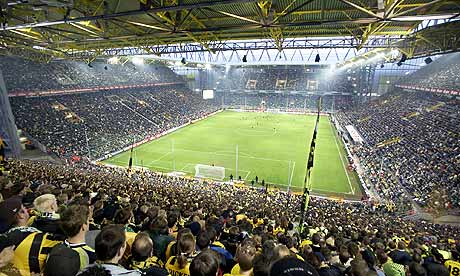
Borussia Dortmund's Westfalenstadion is home to the world's largest stand, where the average ticket price is just €15. Photograph: Michael Sohn/AP
In Germany the fan is king. The Bundesliga has the lowest ticket prices and the highest average attendance of Europe's five major leagues. At Borussia Dortmund their giant stand holds 26,000 and costs little more than £10 for admission. Clubs limit the number of season tickets to ensure everyone has a chance to see the games, and the away team has the right to 10% of the available capacity. Match tickets double as free rail passes with supporters travelling in a relaxed atmosphere in which they can sing, drink beer to wash down their sausages, and are generally treated as desirables: a philosophy English fans can only dream of.
The Bundesliga may be Europe's only fit and proper football league – the sole major domestic competition whose clubs collectively make a profit – yet no German team has won the Champions League for nine years. This success rate, though, could be about to change following Bayern Munich's advance to the semi-finals, following their thrilling disposal of Manchester United last week at Old Trafford.
"The Bundesliga as a brand, a competition, is in good shape. We have a very, very interesting competition, a stable and sustainable business model that relies on three revenue sources," the Bundesliga chief executive, Christian Seifert, tells Observer Sport. A holy trinity comprising match-day revenue (€424m), sponsorship receipts (€573m) and broadcast income (€594m) is the main contributor to the Bundesliga's €1.7bn turnover.
A glance at the continent's other major leagues confirms the state the sport is in. On these shores Portsmouth dice with extinction, while Manchester United and Liverpool build mammoth debt mountains. In Spain, where debts are just as high, La Liga players may strike because of unpaid wages in the lower divisions. The stadiums of Italy are half-filled, and in France their clubs spend more of their income (71%) on players' wages than those of any country.
Seifert says the success of the Bundesliga is because of the "core value" of the supporter coming first at its clubs. This is why tickets are kept so cheap. "Because the clubs don't ask for more money," he explains. "It is not in the clubs' culture so much [to raise prices]. They are very fan orientated. The Bundesliga has €350m less per season than the Premier League in matchday revenues. But you could not from one day to another triple prices.
"Borussia Dortmund has the biggest stand in the world. The Yellow Wall holds 26,000, and the average ticket price is €15 (£13) because they know how valuable such a fan culture and supporter base is.
"We have a very interesting situation. First, tickets are cheap. Second, many clubs limit the percentage of season tickets. For instance, Borussia Dortmund, Schalke 04, Hamburg, Bayern Munich. They want to give more fans the chance to watch games live. If you have 80%, 100% then it is all the same people in the stadium. Also in Germany the guest club has the right to 10% of the tickets for its fans."
Last season La Liga attracted an average of 28,478 fans, Ligue 1 21,034, Serie A 25,304 and the Premier League 35,592. These figures are dwarfed by the Bundesliga's average of 41,904. Its soaring attendances are matched by a balanced approach to salaries. "The crucial thing in last year's €1.7bn turnover and €30m profit was that Bundesliga clubs paid less than 50% of revenue in players wages," Seifert says. This is the continent's lowest. In 2007‑08 [the most recent available year] the Premier League paid out 62%.
All this prudent financial management is achieved despite the Bundesliga's television income being a modest €594m compared with the Premier League's lucrative return of €1.94bn. Seifert explains the disparity. "The TV market in Germany is very special. When pay-TV was introduced in 1991 the average household already received 34 channels for free. Therefore we had the most competitive free TV market in the world, so this influenced the growth of pay-TV very much. We were forced to show all of the 612 games of the Bundesliga and second Bundesliga live on pay-TV. So we have to carry the production costs of this."
No Bundesliga team has won the Champions League since Bayern Munich beat Valencia in 2001 and its last finalist was Bayer Leverkusen, eight years ago. But Seifert disputes whether the small return from television rights has been a defining factor in this record. "Money-wise, Bayern Munich is ranked in the first four clubs of Europe. And bear in mind even Chelsea, which spent a hell of a lot of money in the last years, didn't win it. Sometimes you could have the feeling that the ability to win the Champions League goes in line with your willingness to burn a hell of a lot of money. For that reason I think Uefa is on very good track with their financial fair play idea."
Deloitte's accountancy figures for the 2007-08 season show all but one Premier League club (Aston Villa) to be in debt. Compare this with the Bundesliga report for last season, which offers a markedly disappointed tone when recording that "only 11 of the 18 clubs are now in the black".
Pressed further on the lack of success in Europe's premier club competition Seifert argues for sport's cyclical nature. "At the end of the 1990s the Bundesliga was the strongest in Europe. In 1997 we had won the Champions League [Borussia Dortmund] and the Uefa Cup [Schalke]," he says.
"Then in 1999, 2001 and 2002 we were in the final at least. In those days the Premier League had more money, too. It depends not only on money but the quality you have – if it only depended on money then Porto wouldn't have played Monaco in the 2004 final."
Seifert also points to German football's success in producing its own players. This is borne out by Germany being European champions at under-17, under-19, and under-21 level. "The Bundesliga and German FA made a right decision 10 years ago when they decided that to obtain a licence to play you must run an education camp [academy]. The Bundesliga and second Bundesliga spend €75m a year on these camps.
"Five thousand players aged 12-18 are educated there, which has now made the number of under-23-year-olds in the Bundesliga 15%. Ten years ago it was 6%. This allows more money to be spent on the players that are bought, and there is a bigger chance to buy better, rather than average, players," Seifert says of a league in which the stellar performers currently include Bayern's Frank Ribéry and Arjen Robben.
"When Bayern played against Manchester United Philipp Lahm, Bastian Schweinsteiger, Holger Badstuber and Thomas Müller were all homegrown," Seifert says. "So yes, it's a cyclical environment and you have to deal with that. Therefore I'd deny that you could really say whether a league is strong or weak just because one club wins or does not win the Champions League."
Seifert's view is supported by Arsenal having followed United out of the competition last week, when Arsène Wenger's team were dismantled by Barcelona, to leave no Premier League presence in the semi-finals for the first time since 2003. And for the 2012-13 season Germany should have four places in the Champions League as by then they should have overtaken Serie A in Uefa's five-year coefficients.
Seifert also has Spain in his sights. "If we consider our financial capabilities and the stability of our business model, then the aim of the Bundesliga in the long run has got to be second place behind the Premier League," he says.
Of all the Bundesliga's regulations, the recent history of English football suggests it might have benefited most from the 50+1 rule. This states that members of a club must retain at least 51% ownership, so preventing any single entity taking control. Portsmouth are the most glaring example of how an outsider might potentially ruin a club – their administrator is currently searching for their fifth owner of this season – and the Bundesliga recently reiterated the commitment to the rule following a challenge from Hannover 96.
Martin Kind, Hannover's president, wished to change the regulation. He told Observer Sport: "The rule means the loss of many Bundesliga clubs' ability to compete nationally and internationally. And in some ways it prevents further development of German football, especially those clubs who play in the lower half of the Bundesliga as they do not have enough financial resources. The ownership rule should be abandoned or modified."
While Kind adds that his lawyers believe he has a "good chance" of winning the case when it is heard at the court of arbitration for sport this year, Seifert is proud that when the 36 clubs that comprise the Bundesliga's two divisions voted on the issue "35 were against".
There are exceptions to the 50+1 rule. Yet even these appear couched in common sense. Seifert again: "Bayer Leverkusen and Wolfsburg [whom Fulham knocked out of the Europa Cup on Thursday] are two. If a company is supporting football in a club for more than 20 years then it can acquire the majority. The idea is that a company has by then proved to fans and the league that they take their engagement in the Bundesliga seriously, that it's not just a fancy toy or part-time cash injection that [could] change from one day to another."
What the Bundesliga does allow to be transformed from one season to the next is the prospect of any and all its clubs mounting a realistic tilt at the title as Wolfsburg's triumph, the first in their 64-year history, proved last season.
"In the last three years of the Bundesliga we have three different cup winners and three different champions," Seifert says. "Sepp Herberger, the coach of the West German team that won the 1954 World Cup, said: 'You know why people go to the stadium? Because they don't know how it ends.'"


